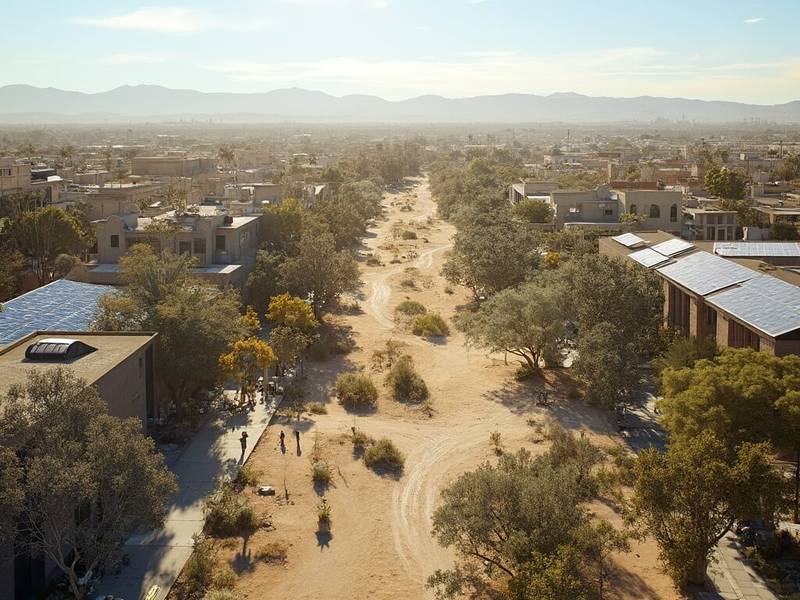
Fresno, as with much of the Central Valley, has always been quite hot, and anybody who lives in or visits Fresno during the summer knows just how miserably hot it can be. It’s a kind of heat that sticks to you, that turns a quick walk to the mailbox into a tactical decision, and that feels worlds apart from the breezy afternoons of San Diego or the fog‑cooled evenings of San Francisco. But why?
🌡️ The Heat Belt Is No Longer a Warning — It’s Here
The Central Valley has always been hot, but the last decade pushed it into a new category: sustained, compounding, infrastructure‑breaking heat. Fresno, Bakersfield, and Merced now see 20 to 40 or more days above 105°F each year, and nighttime cooling is collapsing — the Valley often stays above 80°F well past midnight. Heat waves arrive earlier, last longer, and return more frequently, while farmworkers, delivery drivers, and other outdoor laborers face the highest exposure. This isn’t “California heat.” This is structural heat, the kind that reshapes cities, budgets, and public health.
🚰 Heat + Water = The Valley’s Defining Battle
The Heat Belt sits on top of the most politically contested water system in the country, and the tension between heat and water defines the region’s future. Reservoirs can swing from flood to drought in the same year, groundwater pumping continues to cause subsidence that damages canals, and cities like Fresno and Clovis are racing to expand recharge basins to bank as much water as possible. Agriculture is shifting toward heat‑tolerant, high‑value crops, but the irony remains: the region that feeds the nation is also the region most strained by the climate that agriculture helped shape.
🏙️ Cities Are Adapting — But Not Fast Enough
Some cities are innovating, while others behave as if summer is still 1998. Fresno’s tree canopy remains one of the lowest among major U.S. cities, and although cooling centers exist, many residents cannot easily reach them. Older neighborhoods absorb and radiate heat like a skillet long after sunset, and EV adoption lags because charging deserts mirror the same neighborhoods that lack shade and infrastructure. The Heat Belt exposes a truth California doesn’t like to admit: climate resilience is a ZIP‑code privilege.
The Human Side: Who Gets Hurt First
Extreme heat hits hardest where people have the least buffer. Farmworkers labor in 110°F fields with limited shade, renters in older apartments face skyrocketing AC bills, and homeless residents endure nighttime temperatures that no longer cool enough to be survivable. Elderly residents in rural towns often lack access to reliable cooling or transportation. Heat is not just a weather event — it is a public health crisis with a measurable body count.
🔮 The Future: The Valley as America’s Climate Test Case
Here’s the twist: the Heat Belt isn’t just suffering — it’s becoming a national model. Cities are experimenting with reflective pavement, water agencies are redesigning recharge systems, farmers are adopting robotics and drought‑tolerant crops, and researchers are studying heat‑resilient urban design in Fresno and Bakersfield. If the Valley can adapt, the rest of inland America can too.
Sources
California Department of Water Resources — Climate & Water Data https://water.ca.gov/Water-Basics/Climate-Change
National Weather Service (NWS) — Fresno Climate Records https://www.weather.gov/wrh/climate?wfo=hnx
California Office of Environmental Health Hazard Assessment — Heat & Public Health https://oehha.ca.gov/climate-change/general-info/extreme-heat
UC Merced — Central Valley Climate & Agriculture Research https://news.ucmerced.edu
CalEnviroScreen (California EPA) — Heat Vulnerability & Environmental Exposure https://oehha.ca.gov/calenviroscreen
NOAA Climate Data — Heat Trends in the Western U.S. https://www.ncdc.noaa.gov