California’s push toward a zero‑emission future has put EVs at the center of every policy debate, but the reality on the ground is more complicated. Charging infrastructure is uneven, long‑distance travel still requires planning, and not everyone can plug in at home. That’s why the state’s 2035 goal—while ambitious—needs a practical bridge for the millions of drivers who aren’t ready to go fully electric. And that bridge already exists: hybrids and plug‑in hybrids.
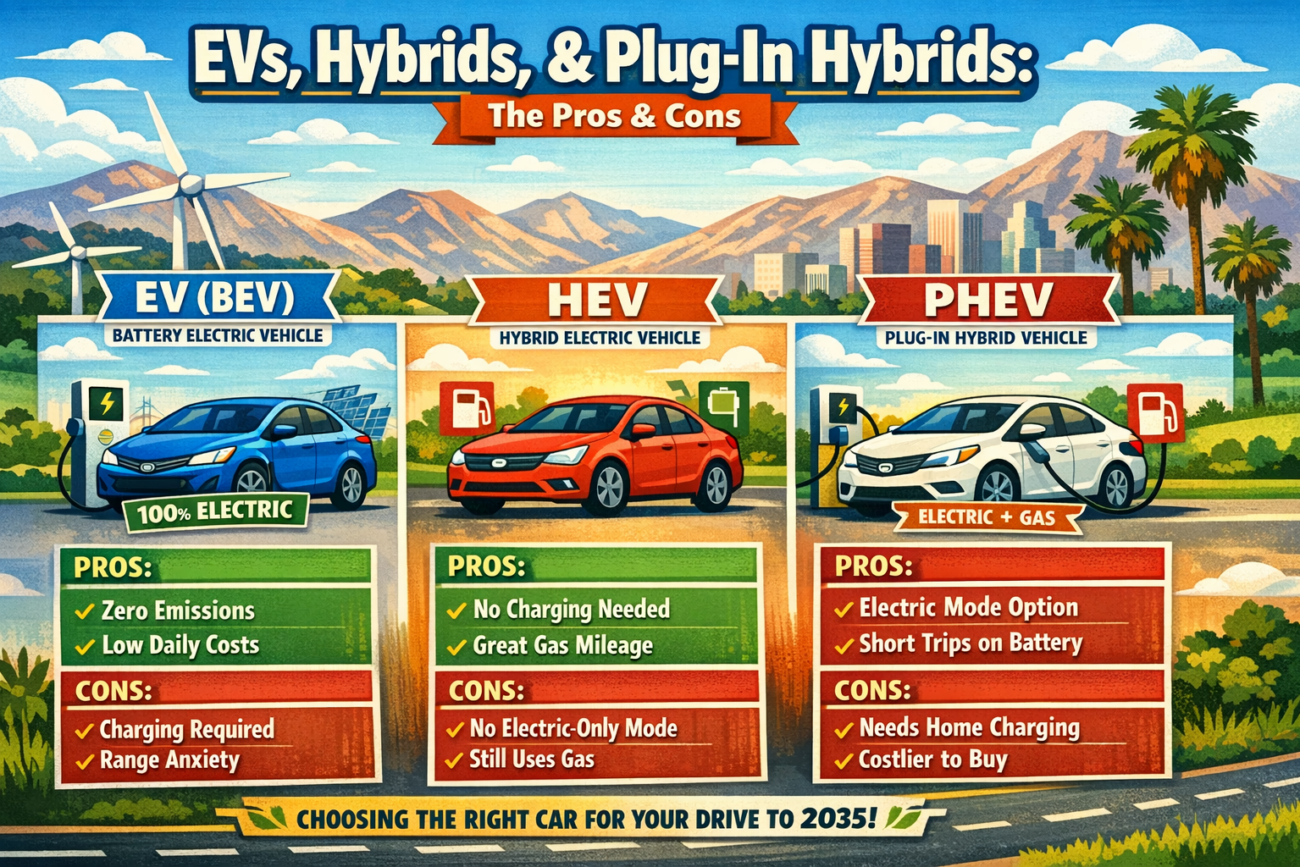
Standard hybrids (HEVs) remain the most underrated option in California’s clean‑car conversation. They don’t need charging, they deliver excellent gas mileage, and they’re usually only a modest price bump over their gas‑only counterparts. For commuters, families, and anyone who just wants a reliable car that sips fuel instead of chugging it, HEVs quietly do the job without demanding lifestyle changes.
Plug‑in hybrids (PHEVs) offer something different: a short all‑electric mode—usually 20 to 40 miles—that’s perfect for errands, school runs, and local commutes. But that benefit only pays off if two things are true: you mostly take short trips, and you can charge at home. Without home charging, a PHEV becomes a heavier, more expensive hybrid that rarely uses its electric capability. And if your daily driving exceeds the electric range, you’re back to burning gas anyway.
So as California races toward 2035, the smartest path isn’t EV‑or‑nothing. It’s acknowledging that HEVs and PHEVs are essential stepping stones for millions of drivers navigating cost, infrastructure, and practicality. EVs may be the destination, but hybrids are the on‑ramp—and California’s transition will be smoother if we treat them that way.
The EV Reality Check: Is California Actually Ready for 2035?