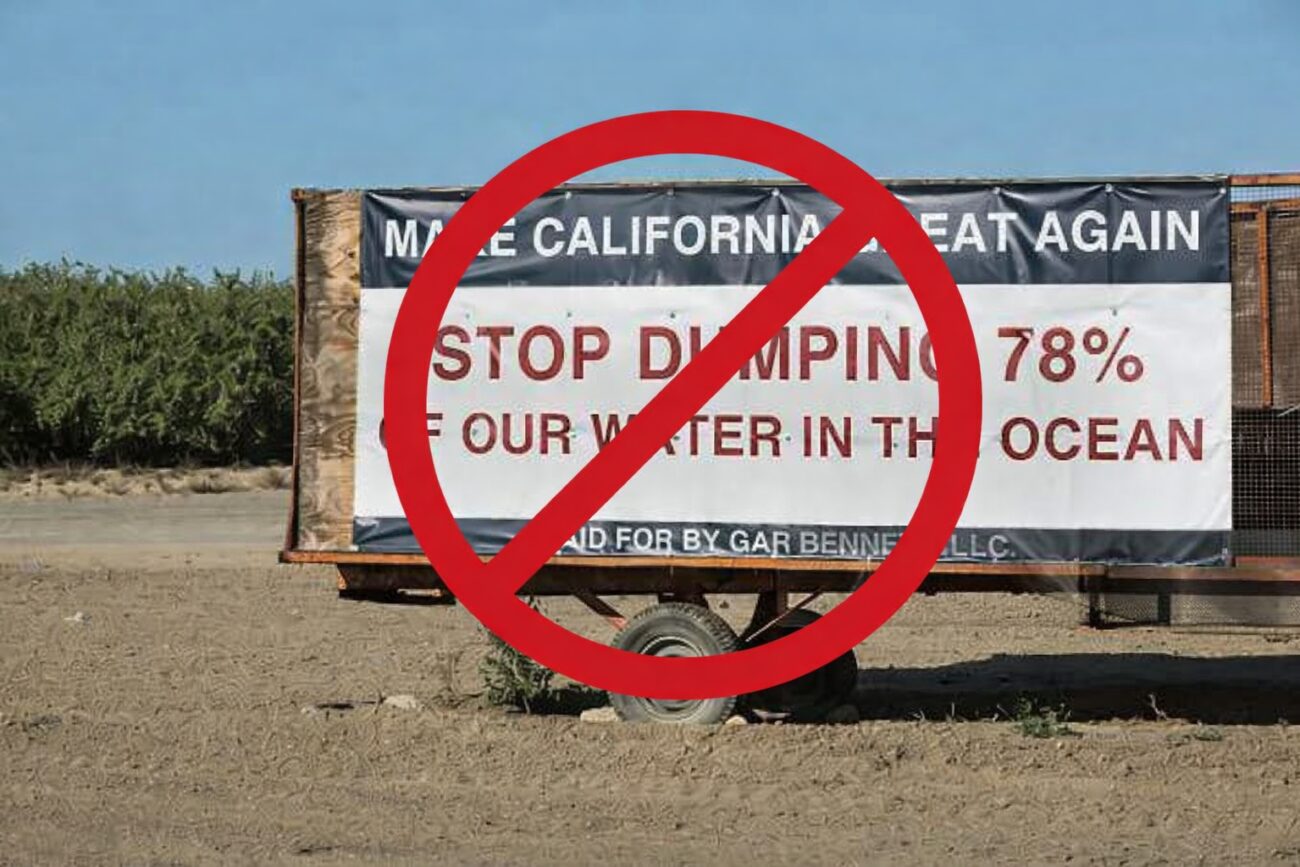
California’s water system is one of the most misunderstood pieces of infrastructure in the country. Every few years—usually during a drought or a political cycle—someone (or something, such as the occasional sign on a Central Valley farm somewhere) claims that California is “dumping water into the ocean for no reason.” It sounds outrageous. It’s also wrong. The truth is far more interesting, far more scientific, and far more Californian.
1. A Water System Built to Overcome Geography
California’s population and its water supply live in opposite ends of the state. Northern California receives most of the rain and snow, while Southern California holds most of the people. Meanwhile, the Central Valley—semi‑arid by nature—produces a quarter of America’s food. To make this geography workable, engineers built the State Water Project and the Central Valley Project, two massive systems that move water hundreds of miles and thousands of feet uphill. These systems were never designed with “extra” water to waste; every drop is allocated, tracked, and fought over. The idea that California casually discards water ignores the reality that the entire state depends on carefully managed movement of water from where it naturally falls to where people and farms actually exist.
🐟 2. Why Water Must Reach the Ocean for the System to Function
The claim that California “dumps water into the ocean” misunderstands the basic function of rivers. Rivers are supposed to reach the ocean. That flow maintains the health of the Sacramento–San Joaquin Delta, one of the most important estuaries on the West Coast. When freshwater flows out to the Pacific, it pushes back saltwater intrusion, keeps the Delta drinkable, and prevents the entire system from becoming too salty to use. This isn’t optional—if the Delta becomes brackish, the pumps that send water to millions of Californians must shut down. The flow also sustains wetlands, supports endangered species, and prevents harmful algal blooms. In other words, the water that reaches the ocean is performing essential work. It’s not waste; it’s the ecological equivalent of circulation.
🧪 3. Flow Keeps Water Clean — Without It, the System Breaks Down
One of the most overlooked truths about California’s water is that movement is what keeps it usable. When water sits still, it stagnates. Salinity rises, temperatures increase, oxygen levels drop, and ecosystems collapse. Freshwater flow acts like a cleansing mechanism, cycling out older, saltier, or degraded water and replacing it with cleaner, oxygenated water. This is the same principle behind reservoir releases and the same logic you see at places like the Friant Hatchery, where fish survival depends on constant, healthy flow. Without movement, the Delta would become too salty to drink from, too polluted to pump, and too unstable to support the fisheries and wetlands that benefit the entire state. Flow isn’t waste — it’s maintenance.
🌎 4. The “Dumping Water” Myth Exists Because Politics Oversimplifies Reality
The idea that California wastes water didn’t come from scientists or water managers—it came from political rhetoric. California’s water system is a hydrological, legal, biological, and climate‑driven balancing act. It involves federal agencies, state agencies, local water districts, tribal rights, agricultural demands, environmental protections, and court rulings. Reducing all of that to “dumping water” is like saying California wastes electricity because power lines don’t store energy. It’s a catchy line, but it ignores the complexity of a system designed to serve tens of millions of people while preserving ecosystems that benefit us too. Healthy fisheries, wetlands, and estuaries aren’t luxuries—they’re part of the infrastructure that keeps our water clean and usable.
5. The Real Story: California’s Water Cycle Protects the State
When water flows to the ocean, it is doing exactly what it must do to keep California functioning. It protects drinking water by preventing saltwater intrusion. It preserves ecosystems that support fisheries, including hatcheries like the one at Friant. It maintains salinity balance, which is essential because water that becomes too salty is effectively unusable. It prevents infrastructure damage, supports agriculture, and keeps the Delta from collapsing. California’s water managers aren’t wasteful—they’re performing a delicate balancing act that keeps the state alive. The flow to the ocean is not a mistake; it’s the system working exactly as intended.
Sources & Further Reading
Much of the information about California’s water system comes from public agencies and research institutions that study the Delta, river flow, salinity, and statewide water movement. The California Department of Water Resources provides detailed explanations of Delta salinity control, freshwater outflow, and how the State Water Project operates. Their main site is: https://water.ca.gov/
The U.S. Bureau of Reclamation offers extensive documentation on the Central Valley Project, including Friant Dam, Millerton Lake, and the Delta pumping system that supplies millions of Californians. Their Central Valley Project overview is here: https://www.usbr.gov/mp/cvp/
For ecosystem science and Delta health, the Delta Stewardship Council publishes accessible reports on salinity, fish populations, and the ecological role of freshwater flow in keeping the estuary alive. Their site is: https://deltacouncil.ca.gov/
NOAA Fisheries provides research on salmon runs, hatcheries, and how river flow supports endangered species — including the same principles used at the Friant Hatchery. Their main site is: https://www.fisheries.noaa.gov/
The Friant Water Authority offers region‑specific insight into Friant Dam operations, San Joaquin River restoration, and why controlled releases are essential for water quality and fish survival. Their site is: https://www.friantwater.org/
For nonpartisan statewide analysis, the PPIC Water Policy Center publishes some of the clearest explanations of California’s water challenges, including drought cycles, groundwater depletion, and climate impacts. Their water research hub is: https://www.ppic.org/water/
Finally, the USGS California Water Science Center provides real‑time data and long‑term studies on hydrology, salinity, groundwater, and Delta flow patterns. Their site is: https://ca.water.usgs.gov/