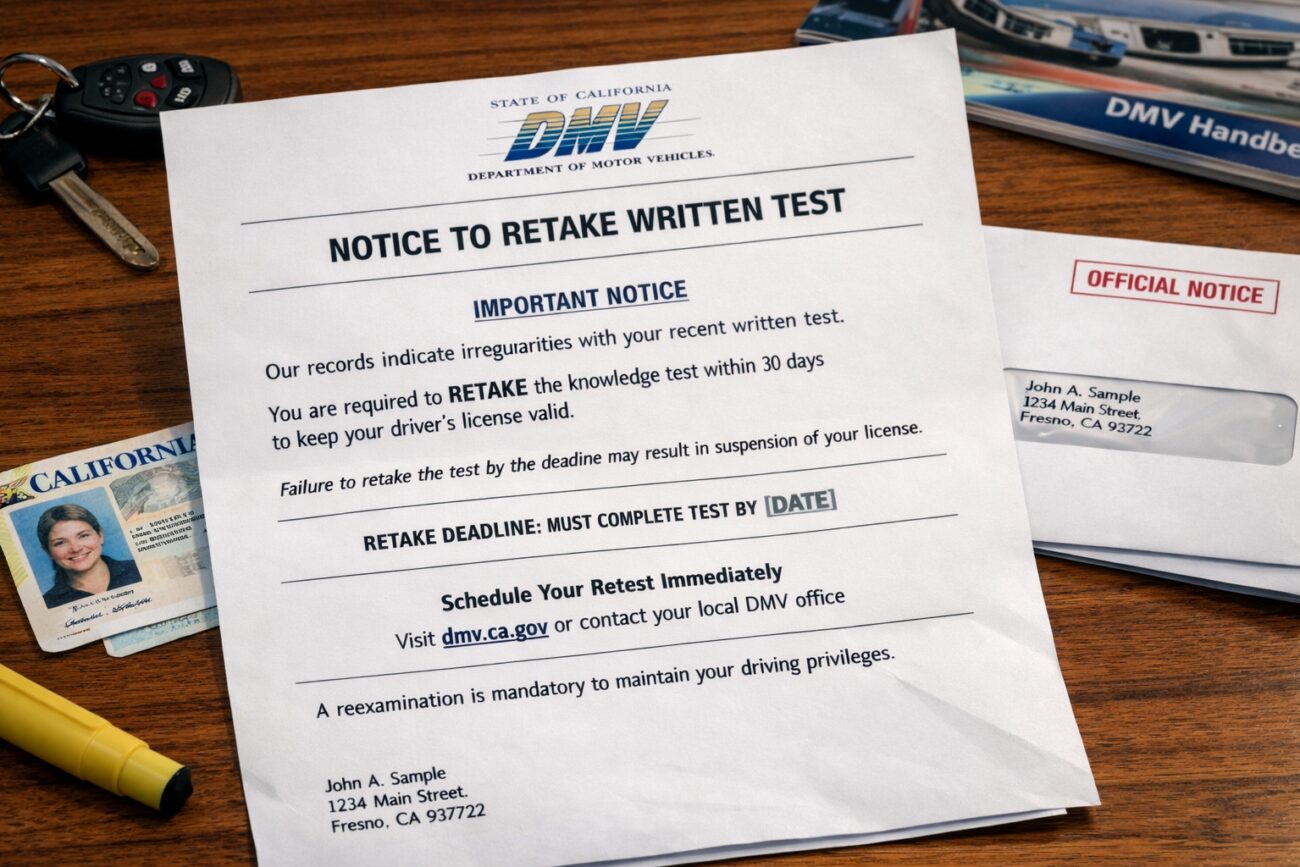
California drivers are being told to head back to the DMV — not for a renewal, not for a correction, but to retake the written test they already passed months ago. According to the DMV, roughly 11,000 Californians received letters stating their original exam showed “irregularities” that may indicate cheating. Anyone who doesn’t retake the test within 30 days risks losing their license. The DMV insists this isn’t a glitch or a system error. Instead, the agency says its internal monitoring flagged patterns that “may indicate instances of cheating,” and some cases have already been referred to prosecutors. But the DMV’s silence on how cheating supposedly occurred has left thousands of drivers confused — and many Fresno residents rolling their eyes at yet another example of the DMV’s opaque testing standards.
The DMV’s written exam is famously straightforward, with most questions covering common‑sense rules like right‑of‑way basics, speed limits, signage recognition, and the perennial “What do you do at a flashing red light?” It’s the kind of test most people pass on the first try. So when the DMV claims thousands of people may have cheated, the reaction across California has been disbelief. Drivers interviewed statewide said they assumed the letter was a scam or a clerical mistake, and many asked the obvious question: why would anyone cheat on a test this simple? The DMV hasn’t answered that, nor has it disclosed the cheating method, the locations involved, or the specific anomalies it detected. That silence has created a vacuum — and confusion is filling it.
If you ask Fresno drivers what part of the licensing process is stressful, almost nobody says the written test. The real anxiety comes from the behind‑the‑wheel exam, where grading can feel inconsistent, subjective, and sometimes contradictory to how people actually drive in the Central Valley. Fresno’s intersections are a patchwork of designs: some have dedicated right‑turn lanes, some have bike lanes that double as de facto right‑turn lanes, and some have neither, forcing drivers to improvise. During a driving test, that improvisation can get you dinged. One examiner might treat entering the bike lane before a right turn as normal, while another might mark it as “riding the bike lane,” even though stopping abruptly in the through‑lane to make a right is arguably more dangerous and more likely to cause a backup. Add in the Valley’s infamous rolling stops — a habit so widespread that enforcing a perfect stop feels almost theoretical — and it’s no wonder Fresno drivers often feel the driving test is the real hurdle. Which is why this retesting order feels backwards: if someone passed the driving test, why would the DMV question the written one months later?
The DMV’s public statements boil down to three points: irregularities were detected in certain written test results between July 2025 and April 2026; these irregularities may indicate cheating; and some cases have been forwarded to district attorneys for investigation. The DMV also emphasized that the issue is “test‑taker related,” not a technical malfunction. But the agency has refused to explain the nature of the irregularities, meaning drivers who did nothing wrong may have been swept up in a broad statistical net — flagged because their test looked too perfect, too fast, or too similar to other flagged tests. Without transparency, the public is left guessing.
The DMV’s testing system has always felt like a black box. You take the test, you get a score, and you hope the examiner’s interpretation of your driving matches the reality of Fresno’s roads. Now, thousands of Californians are being told their written test wasn’t valid — months after they passed, months after they received their license, and months after they began driving legally. The DMV says it’s protecting the integrity of the licensing process, but drivers say the agency owes them clarity. If cheating occurred, the public deserves to know how. If innocent drivers were flagged, they deserve to know why. Until then, the DMV’s retest order feels less like a targeted anti‑cheating measure and more like another example of bureaucratic opacity — one that disproportionately frustrates everyday Californians who already view the DMV as a necessary but maddening institution.
For Fresno drivers, the written test has never been the problem. The real challenge is navigating inconsistent grading, ambiguous lane designs, and examiners who enforce rules differently than the city’s actual driving culture. So when the DMV claims thousands of people cheated on the easy part, it’s no surprise that Fresno’s reaction is a collective: really? Whether cheating occurred or not, the DMV’s lack of transparency is the story — and until the agency explains its methods, thousands of Californians will be retaking a test they already passed, wondering what exactly they did wrong.
DMV Flags 11,000 Written Tests for “Cheating,” Orders Retakes